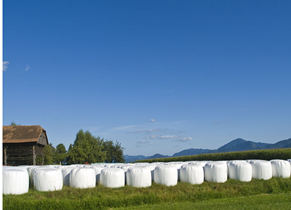
Outdoor bale storage in inland Australia places heavy demands on stretch film. Intense solar radiation, high summer temperatures and repeated handling can gradually weaken film and reduce the adhesion needed to maintain an airtight seal. Choosing the right silage plastic to wrap bales therefore involves more than checking thickness or stretch percentage. UV stabilisation, tack retention, puncture resistance and film memory all need to work together throughout the intended storage period. Australian suppliers commonly specify UV protection for local conditions, with some products rated for particularly high solar exposure.
Why Solar UV Degrades Bale Wrap
Ultraviolet radiation can initiate oxidation in polyethylene film. Over time, this can contribute to embrittlement, loss of elongation and reduced mechanical strength. For wrapped bales sitting outdoors, degradation becomes particularly important when the film must remain intact for many months.
The issue is not simply whether a film survives sunlight. It must retain enough flexibility and surface adhesion to keep overlapping layers sealed together. Agriculture Victoria recommends regularly inspecting wrapped silage and promptly repairing any holes, as maintaining an airtight package is essential to protect stored forage.
What HALS Does
Hindered Amine Light Stabilisers, or HALS, are commonly used in polyethylene products to slow photo-oxidative degradation. Rather than treating HALS as a simple percentage specification, buyers should assess the complete UV stabilisation package and its verified exposure rating.
No universal HALS concentration guarantees performance at a particular level of solar exposure. Formulations vary by resin type, film construction, pigment package, stabiliser combination, thickness, and manufacturing process. Therefore, a supplier claiming performance to 180 kLy should provide product-specific technical documentation rather than relying on a generic HALS percentage. Some Australian silage-cover products are explicitly marketed with ratings around 180 kLy.
Protecting Tack During Hot Storage
UV degradation and heat can affect more than tensile strength. The film must continue bonding effectively where layers overlap. Good tack helps maintain an airtight seal and limits pathways for oxygen ingress.
A UV-stabilised agricultural packaging to wrap bales in inland Australia should therefore be evaluated for both UV durability and adhesion after exposure. Product specifications that mention tack, cling, tensile strength, puncture resistance and UV protection provide more useful information than a UV additive claim alone. Some Australian films publish formal cling measurements and UV guarantees, illustrating the value of measurable performance data.
Practical Selection Checks
Before buying silage plastic to wrap bales, ask the supplier for:
● The stated UV exposure rating or warranty period.
● Recommended storage duration under outdoor conditions in Australia.
● Film thickness and multilayer construction.
● Tack or cling performance specifications.
● Recommended stretch percentage for the wrapper.
● Evidence of puncture and tear resistance.
● Guidance for storage in high-temperature inland regions.
Do not assume that increasing HALS concentration alone solves every problem. Excessive or poorly balanced additive packages can affect processing and other film properties, while insufficient stabilisation may leave the polyethylene vulnerable to long-term UV exposure.
Managing Bales in Inland Heat
Film selection should be combined with good storage practice. Keep wrapped bales on a suitable, cleared surface and inspect them regularly for punctures, animal damage and signs of film deterioration. Prompt repairs are important because even a small hole can compromise the sealed environment.
White or lighter-coloured films can also help manage heat. Some Australian silage-cover systems use a white outer layer specifically to reflect solar energy and reduce heating.
Conclusion
For inland Australian storage, silage plastic to wrap bales needs to retain strength, flexibility and tack throughout its rated UV exposure. A claimed 180 kLy capability should be supported by product-specific testing or warranty information, not simply an advertised HALS concentration.
When selecting UV-stabilised silage plastic to wrap bales in inland Australia, compare the complete film specification, including UV rating, tack, stretch performance, and puncture resistance. Ask suppliers for technical data before committing to long-term outdoor storage.
Need film for demanding inland conditions? Speak with a silage-wrap supplier about the expected storage period, local solar exposure and wrapper settings, then select a film whose documented performance matches those conditions.
—
FAQs
1. What does HALS do in silage plastic?
HALS helps slow UV-driven photo-oxidative degradation in polyethylene, helping the film retain mechanical properties during outdoor exposure.
2. Is there a specific HALS concentration required for 180 kLy?
There is no universal concentration. The required formulation depends on the resin, stabiliser system, pigments, film construction and manufacturing process. A verified exposure rating is more useful than a generic additive percentage.
3. Why does tack matter in silage wrap?
Tack helps adjacent film layers adhere to one another, supporting an airtight package and reducing opportunities for oxygen ingress.
4. Is 180 kLy suitable for inland Australian storage?
A film rated to 180 kLy is designed for substantial solar exposure, but suitability still depends on the product’s documented test conditions, warranty and intended storage duration.
5. What else should farmers check besides UV resistance?
Check tack, stretch performance, puncture resistance, tear strength, film thickness, multilayer construction and the manufacturer’s recommended storage period.